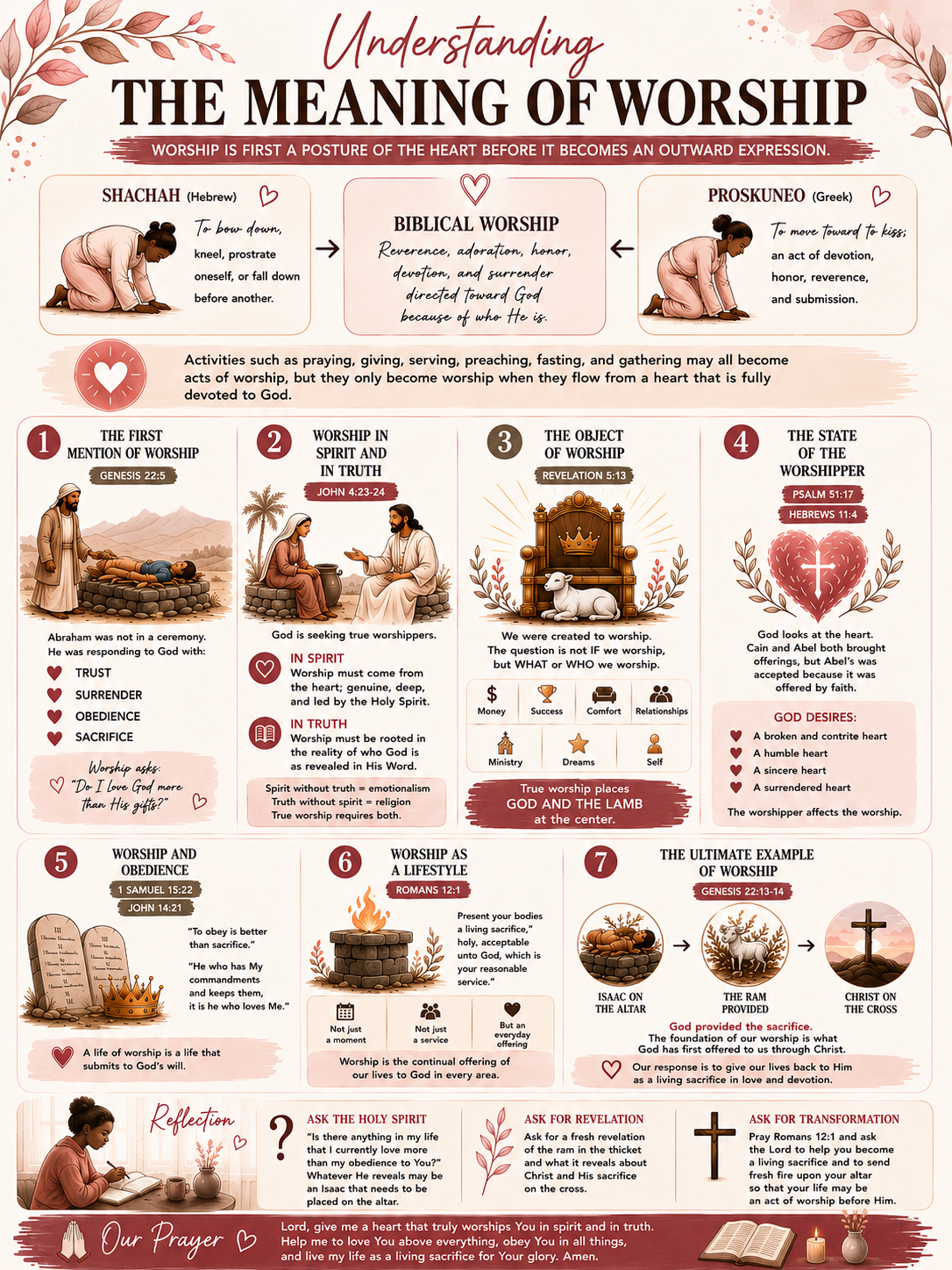
Understanding the Meaning of Worship
Worship is one of those words that many of us use often, yet few of us stop to define.
For some, worship is a song. For others, it is a Sunday morning experience or a moment during prayer when God's presence feels especially near. While worship can certainly include those things, Scripture presents a much deeper picture.
The first time worship appears in the Bible, there is no choir, no instrument, and no congregation gathered together. Instead, we find Abraham walking up a mountain with Isaac, carrying within him a profound mixture of faith, surrender, trust, and obedience. This first mention immediately teaches us that worship is far more than an activity; it’s a response to God's worthiness.
As I spent time studying worship during our Amos 9:11 fast, I found myself challenged by a simple but searching question:
What does God actually mean when He says He is seeking worshippers?
The answer led me through Genesis 22, John 4, Revelation 5, Romans 12, and several other passages that reveal worship not merely as something we do, but as a posture of the heart and ultimately a way of life.
These notes summarize what we explored in Bible study as we sought to understand what true worship is, who God is seeking, and how our lives can become an offering that honors Him.
Key Scriptures
Genesis 22:1-14 | John 4:20-24 | Revelation 5:4-14 | Psalm 51:17 | Hebrews 11:4 | 1 Samuel 15:22 | John 14:21 | Romans 12:1
Understanding What Worship Is
One of the most common misconceptions about worship is that it is primarily an activity. However, Scripture presents worship as something much deeper than an activity; it is first a posture of the heart before it becomes an outward expression. Biblically, worship is reverence, adoration, honor, devotion, and surrender directed toward God because of who He is. It is the response of a heart that has encountered God's worthiness and chooses to submit to His lordship.
To better understand worship, it is helpful to look at the original biblical languages.
In the Old Testament, the primary Hebrew word translated as worship is shachah, which means to bow down, kneel, prostrate oneself, or fall down before another. It paints the picture of someone humbling themselves before a king in recognition of his authority and worth.
In the New Testament, the primary Greek word translated as worship is proskuneo, which carries the idea of moving toward to kiss, as one would kiss the hand of a king. It communicates affection, devotion, honor, reverence, and willing submission.
Together, these two words provide a fuller picture of worship. Worship is not merely bowing before God as King; it is responding to Him with reverence, affection, devotion, surrender, and love. It is both an inward posture and an outward response. Because of this, worship cannot be reduced to a specific activity. Activities such as praying, giving, serving, preaching, fasting, and gathering with other believers may all become acts of worship, but they only become worship when they flow from a heart that is fully devoted to God.
The First Mention of Worship
The first mention of worship in Scripture appears in Genesis 22:5 when Abraham says:
"Stay here with the donkey; the boy and I will go over there and worship, and then we will come back to you."
This passage is significant because it introduces us to God's definition of worship. Abraham was not participating in a religious ceremony. He was responding to a difficult instruction from God that required trust, surrender, and obedience. God had asked Abraham to place Isaac (the promised son, the fulfillment of God's promise, and the hope of his future) on the altar.
For Abraham, worship involved far more than performing a religious act. It was an expression of reverence, adoration, trust, and obedience toward God. Abraham's willingness to obey demonstrated that he valued God above even the most precious gift he had received from Him. Isaac represented more than a son. He represented the promise, the future, the blessing, and the fulfillment of God's word. Yet Abraham was willing to surrender even that. This teaches us that worship is ultimately about rightly ordering our loves. God is not merely looking for expressions of affection; He is looking for hearts that value Him above every other gift, blessing, ambition, relationship, or desire. This teaches us that worship is not merely expressing affection toward God with our words; it is responding to Him with a heart that honors, trusts, and obeys Him. Genuine worship acknowledges God's worthiness and lordship, leading us to surrender our plans, desires, ambitions, fears, attachments, and expectations to Him.
Worship is both the declaration that God is worthy and the willingness to live in obedience to Him because of who He is. The first mention of worship in Scripture therefore connects worship with surrender, trust, sacrifice, and obedience.
Worship in Spirit and in Truth
One of the clearest teachings on worship is found in John 4, where Jesus speaks with the Samaritan woman. The conversation begins as a discussion about where worship should take place. The Samaritans worshipped on Mount Gerizim, while the Jews worshipped in Jerusalem. The woman wanted to know which location was correct.
Jesus redirected the conversation away from location and toward the nature of true worship.
He said:
"The true worshippers shall worship the Father in spirit and in truth: for the Father seeketh such to worship Him."
This statement reveals something remarkable about the heart of God: He is seeking worshippers. Notice that Jesus does not say that God is seeking religious activity. He is seeking a particular kind of person.
To worship in spirit means worship must come from the deepest part of who we are. It cannot simply be external, ritualistic, or performed out of obligation. It must flow from a genuine relationship with God and a heart transformed by His Spirit.
To worship in truth means worship must be rooted in the reality of who God is. We do not worship according to our own ideas, preferences, emotions, or assumptions about God. We worship Him according to His revealed character and nature as found in Scripture.
Spirit without truth can become emotionalism disconnected from God's Word. Truth without spirit can become a religious activity that lacks genuine love and devotion for God. True worship requires both. God desires worship that is sincere, Spirit-led, and rooted in truth.
The Object of Worship
For something to qualify as worship, we must consider the object of that worship. Human beings were created to worship. The question is not whether we worship, but what we worship. Throughout Scripture, we see that many things compete for the affection, trust, devotion, and obedience that belong to God alone. Money, success, relationships, comfort, reputation, achievement, ministry, pleasure, and personal ambition can all become objects of worship when they begin to occupy the place in our hearts that belongs to God.
Whatever consistently receives our highest affection, trust, obedience, and devotion is functioning as an object of worship.
Revelation 5 provides one of the clearest pictures of worship in all of Scripture. John sees heaven gathered around the throne, directing honor, glory, praise, and adoration to "Him who sits on the throne and to the Lamb."
The worship of heaven is completely centered on God's worthiness. This passage reminds us that true worship is always God-centered. Worship begins with a revelation of who God is. It is the natural response of those who have seen His holiness, majesty, power, mercy, and worth. The focus of worship is not the worshipper. The focus is on the One seated upon the throne.
The State of the Worshipper
Scripture consistently teaches that God is concerned not only with what is offered to Him but also with the condition of the person offering it. One of the earliest examples of this principle is found in the story of Cain and Abel:
Both brothers brought offerings before God, yet God accepted Abel's sacrifice and rejected Cain's. Hebrews 11:4 tells us that Abel offered his sacrifice by faith. The difference was not simply the offering itself, but the heart behind it.
This theme appears repeatedly throughout Scripture. God rejected Saul's sacrifice because it was offered in disobedience. Jesus rebuked the Pharisees because they honored God with their lips while their hearts remained far from Him. Again and again, God demonstrates that He looks beyond outward actions and examines the heart.
This is why David writes in Psalm 51:17:
"The sacrifices of God are a broken spirit: a broken and a contrite heart, O God, thou wilt not despise."
A broken and contrite heart is a heart that has been humbled before God. It recognizes its need for Him, remains teachable, and willingly submits to His authority. The worshipper affects the worship. A proud heart can offer the right sacrifice for the wrong reasons. A surrendered heart offers worship that is pleasing to God because it flows from humility, faith, repentance, and devotion.
God is not merely looking at what we bring before Him; He is looking at who we are becoming before Him.
Worship and Obedience
Throughout Scripture, worship and obedience are inseparable.
In 1 Samuel 15:22, Samuel tells Saul:
"To obey is better than sacrifice."
Saul wanted the appearance of worship without the surrender that worship requires. God rejected the sacrifice because obedience had been abandoned.
Similarly, Jesus teaches in John 14:21:
"He who has My commandments and keeps them, it is he who loves Me."
Love for God is demonstrated through obedience to God. This does not mean obedience earns God's love. Rather, obedience is one of the clearest expressions of a heart that genuinely loves Him.
A life of worship is not measured merely by moments of devotion but by a continual willingness to submit to God's will.
Worship as a Lifestyle
Romans 12:1 expands our understanding of worship even further:
"Present your bodies a living sacrifice, holy, acceptable unto God, which is your reasonable service."
Under the Old Covenant, sacrifices were placed on an altar and died. Under the New Covenant, believers are called to become living sacrifices.
This means worship is not confined to specific moments. Worship becomes the continual offering of our lives to God. Our priorities, relationships, decisions, words, actions, and obedience all become expressions of worship when they are surrendered to Him.
True worship is not merely something we do. It is a way of living before God.
Reflection and Prayer
As we conclude our study, we returned to Genesis 22 and reflected on Abraham's willingness to place Isaac on the altar. The deeper issue in Genesis 22 was not simply sacrifice; it was worship. The test was whether Abraham loved the promise more than the God who made the promise. This is the same question worship confronts in every generation.
What sits on the throne of our hearts? What receives our highest affection, trust, obedience, and devotion?
Spend time asking the Holy Spirit:
"Is there anything in my life that I currently love more than my obedience to You?"
Whatever God reveals may be an Isaac that has occupied a place in your heart that belongs to God alone.
Yet the story does not end with Isaac on the altar. God provided a ram as a substitute sacrifice. The significance of the ram is not merely that Isaac was spared; it is that God Himself provided the sacrifice. This points us forward to Jesus Christ, the Lamb of God, whom the Father provided for our salvation. The foundation of Christian worship is not ultimately what we offer to God, but what God has first offered to us through Christ.
As you pray this week, ask the Lord to reveal any Isaac that needs to be surrendered. Ask Him for a fresh revelation of the ram in the thicket and what it reveals about Christ and the cross. Finally, pray Romans 12:1 and ask Him to teach you what it means to become a living sacrifice and to send fresh fire upon your altar so that your life may become an act of worship before Him.